IT IS A BODY. IT IS YOUR BODY. | 2025-2026
Zoe Meyer's First solo exhibition featuring a multi-year overview and new site-specific works in Modica, Italy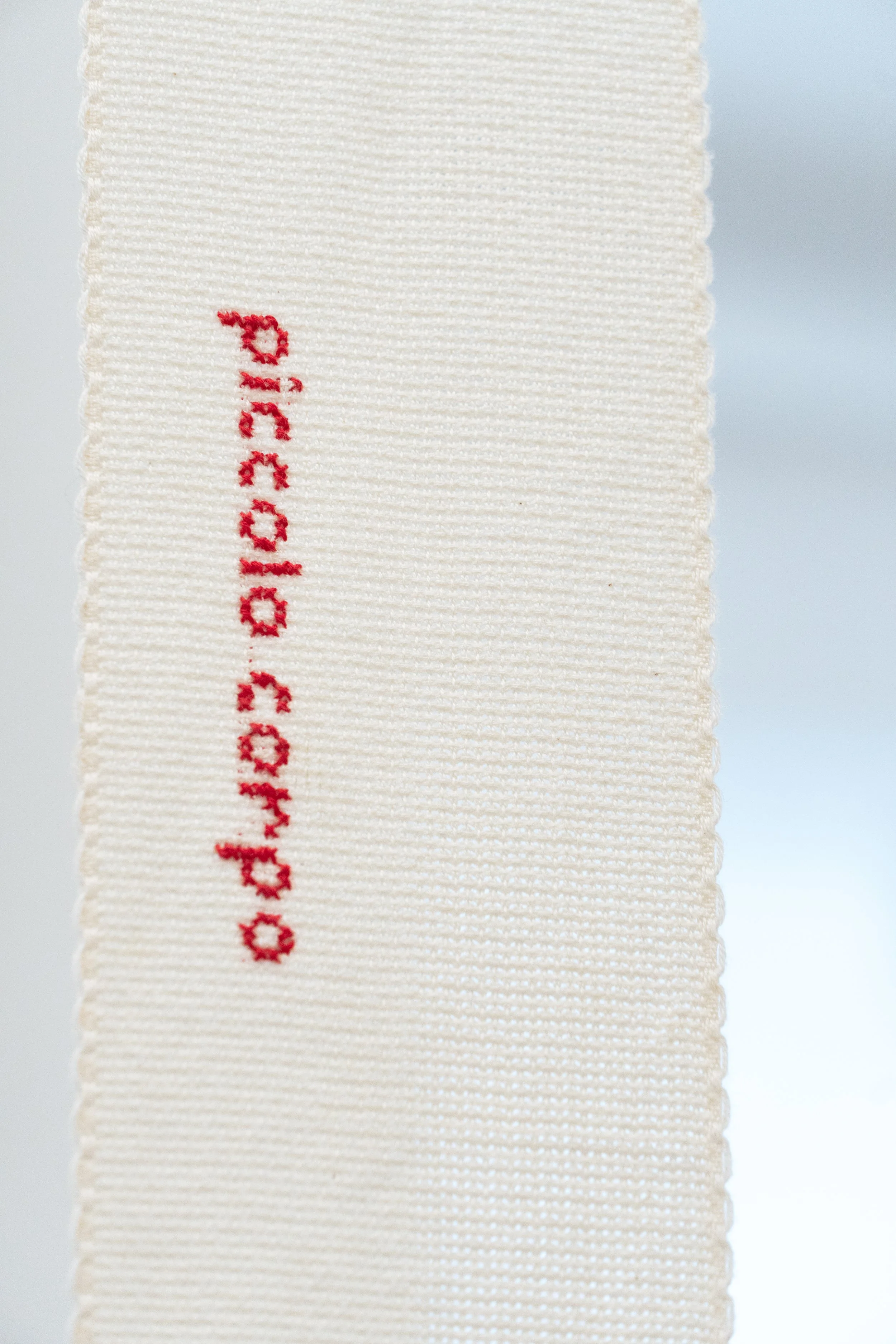
Detail of fresh out of the baths (2023-2024) as part of it is a body. it is your body., Zoe Meyer's solo exhibition, curated by Théo-Mario Coppola, GARAGE FONTANA, Modica, Italy, 2025-2026 | Photo: Studio Zoe Meyer, Courtesy: Zoe Meyer
it is a body. it is your body. is the outcome of a dialogue spanning several years with Zoe Meyer, whose sophisticated, wide-ranging, and ambitious practice is grounded in the mindful acknowledgement that all experience exists between the knowing and the non-knowing, between human and non-human beings, and between the revealed and the referred to, in a state of suspension, uncertainty, and deep-seated inward pursuit.
The title of the exhibition stems from a work bearing the same name. As a mise en abyme, this reference reflects the internal space of a work as well as the core significance of text within the same work, operating as an aphorism or as a short poem, suggesting at once a whole, a detail, and a form of connection between one body and another, between the body of the work and the body of the exhibition, between a human body shaped by sensations, actions and memories. The title and the exhibition reflect Zoe's approach of using repetition and variation in her daily, spontaneous writing to explore themes of existence, experience, wanderings, and comfort. The notion that one body is equivalent to another, or that one body mirrors another, carries an ethical significance. The body of another reminds us of our condition, our vulnerability, reflecting the artist's awareness and otherness as a fundamental guiding force.
The exhibition opens with two works produced in situ by the artist, with left hand (2025) on the left wall and right hand (2025) on the right wall. Two large hands painted in bright red, each taller and wider than a human body, serve to safeguard the exhibition space, holding it all in protective palms and welcoming whoever steps inside.
Zoe Meyer is primarily interested in the transmission of weaving and embroidery techniques between women and in the bonds that unite these women from one household to another, providing them with a point of reference and comfort in facing life's hardships. By embroidering fragments of bodies into scenes, she evokes what has been lost, what has been dulled by time, a communal pooling of parts from a referenced or fictionalised past, tying herself to the women she has met or the women she recalls and honours. diverting it from its primary use, altering it, exposing it to the view of the public, as opposed to the intimate space of the bedroom.
A great, suspended round-shaped structure, february waning (2025) is a single work made of different scenes where text, bodies, and fragments of bodies, whether human or non-human, appear as bits of mythological recountings. They evoke multi-centennial stories, both written and spoken, passed through generations and eras. Partly inspired by personal visions and anchored in literary references, they recall idiosyncratic tales of beings trapped in their own limitations, struggles and expectations, addressing notions of violence, desire, and longing. Yet the scenes are not frontal, and they evoke distant dream-like settings in an imagined world, without being anchored in a specific time, giving space to the viewer. The spectral void left around and in between scenes plays an important role as a meditative and tangible mode of showing the traces of the past and alteration of the fibre. The distinctive, pivotal presence of this large-scale work is intended to encourage circulation and passage between the liminal space of the exhibition and the rest of the exhibition path.
Bodily and embodied dimensions are notably evoked with the video work Geneviève (2019). This film, shot in Super 8 and 16mm and operated on the optical printer, then digitised and edited, addresses confinement and limitation of a patient in care at La Salpêtrière Hospital in Paris during the 1870s. Without showing her and without directly picturing her, the work explores the concept of the body of this patient as a secluded space, in all its inherent variations, as it is shown through shapes, found or created, that continuously recall it throughout time. The outdoor scenes are followed by more abstract images suggesting ontological wandering and a troubled inner life. The film’s ambition is to portray Geneviève by means of absence, suggestion, and introspection rather than presence, direct evocation and transposition. The film leaves room for reflection and imagination against over-interpretation, -analysis and -demonstration of an assertive and peremptory statement. Zoe Meyer affirms her rejection of duality and draws life from experience, from the tenuous ties between sounds and images, from the gaps and pauses in the montage, stitching and stretching space and time, interiority and exteriority.
This non-dual perspective is also reflected in works using fabrics, particularly household fabrics such as tea towels that evoke the kitchen, a space for everyday life, action and conversation between women and generations in the context of Italy, with its marked traditions and gendered distribution of roles, perhaps also becoming a starting point for developing an awareness of being, of sharing with others, and perhaps even a certain sense of revolt, if not freedom.
A large vertical strip of fabric hand-painted with screen printing ink on lenzuola matrimoniali, suspended and curved down to the floor where successive folds reveal parallel red lines, an osmotic barrier (2025) is an attempt to portray and interpret the birth of a line, interrupted and punctuated by the presence of an animal, a dog or fox suspended in mid-air, held in a hypothetical cosmos held together by a pair of hands that suggest they are holding the world and its stability. The line twists and turns before joining the part on the floor, like a metaphor for alternating moments of stability and confusion. In Italy, the use of the terms 'letto matrimoniale' and 'lenzuola matrimoniali' to designate the bed linens and sheets associated with marriage is a strong social marker of the family unit, linked to dowries, the passing on of customs and knowledge and patriarchal power experienced in the culture of Christian union within the confines of the family home in Italy. The terminology has been disseminated as a standard to designate a double bed or double bed sheets, even if they are used for a single person's bed or for individuals who live differently.
Either thought of as rebuses, short stories or visual poems, into the shell you go (2024), odd anatomy (2024), suspended in an unfinished net (2024), untitled towel [2] (2024) and untitled towel [3] (2024) are small-scale works on tea towels and tablecloths, grouped together in a cloud-like arrangement on a separate wall. They invite viewers to look at them independently of one another, but also in relation to one another, like separate micro-worlds or scenes that respond to one another, evoking a surprising hybrid of domestic family atmosphere and vivid visual flamboyance.
big branch (2025) represents a central scene where the enigmatic and referring action suggests an invitation to a distant world full of wildlife.
we are gazing / is this violent (2024) is a ribbon adorned of hand-embroidered verses with cross-stitched texts starting from each ends and meeting in the mid part by Zoe Meyer on ribbons. Applying a similar technique, Zoe Meyer made fresh out of the baths (2023-2024) for which the text was embroidered from one end to another following the left-to-right reading direction. These texts give the impression of personal mysticism, diary entries, fragments revealed from a story written by someone else or pertaining to other lives, or even concise poems wrapped in a myriad of realities and in a world that is not directly visible or accessible to us.
Textual material unfolds in multiple forms and mediums in Zoe Meyer's work, conveying states of mind, reflections, and poetic encounters that express her relationship with inner life, emotional expression, and attempts to depict the world in unconventional tones, as in it is a body. it is your body. (2025) a work of twelve A5-sized ecru paper pages designed to be read from one page to the next. The body is transmuted, altered, made different, sometimes unrecognizable.
The long processes of embroidering, film experimentation, notably through image and sound recording and editing, and writing are all aspects that offer a break from the immediacy of the moment, favouring a deeper form of emotional engagement with the world. By witnessing and testifying about the existence of other bodies, Zoe Meyer celebrates their distinct lives, inherent weakness, hidden suffering, and longings for greater certainty or comfort. Zoe Meyer’s powerful, uncompromising and radical work bears witness to the artist’s independent and refined spirit and her desire to tie threads, fibres, images, spoken and written words beyond divisions and assumptions. Her work constantly travels through missing spaces and indecipherable traces, to acknowledge what it means to express knowledge without fully understanding it, somewhere between what reality brings to experience and what it takes away.
Théo-Mario Coppola
–
1 – Zoe Meyer, it is a body. it is your body. (2025)
2 – To examine the contemporary significance of the combined study of psychotic art, writing and discourse, see Annie G. Rogers, Incandescent Alphabets: Psychosis and the Enigma of Language (London: Routledge, 2016). This work is a key reference for Zoe Meyer's approach, which considers the known, lesser-known and inaccessible connections between language, psyche and its written, spoken and unformulated cultural aspects. Annie G. Rogers was also Zoe Meyer’s professor and close mentor at Hampshire College, Amherst, Massachusetts, The United States.
3 – The context of the exhibition in Modica, Sicily reflects the artist's interest for Southern Italy and Sicily as well as the expanded Mediterranean legends, history and geography. With a sharp, experimental and poetic feminist approach, internationally acclaimed Italian philosopher, feminist thinker and scholar in history and political philosophy Adriana Cavarero developed a speculative and far-reaching hypothesis on the role and image of Penelope as a active figure of the Antique reinventing temporality by her weaving as developed in Adriana Cavarero, In Spite of Plato (London: Routledge, 1995). Zoe Meyer has apprehended such a research as the radical starting point for her own positioning and practice in relation to the women referenced and honoured in her art works as well as the cultural memory and legacy inherent in these practices.
4 – Although the concept of witnessing is fundamental to the position of contemporary artists driven by research, social history, archaeology or philology, it is hardly ever discussed as such. In Zoe Meyer's work, the position of first- or second-hand witness is an entry point for conveying information and blind spots about the lives of humans and non-humans, past and present, known and hypothetical. From her initial position as a witness, Zoe Meyer becomes a testimonial voice through her works. For further discussion on ethical issues related to testimony, including visual arts see Jane Blocker, Visuality and the Ethics of Testimony (Minneapolis: University of Minnesota Press, 2009).
5 – Zoe Meyer’s approach consists indeed in bringing to experience of the works a reality that is merely not accessible. Her approach is deeply grounded in a reflection made by Gloria Anzaldúa in a thematic paragraph under the name La facultad in her work Borderlands/La Frontera: The New Mestiza where she reveals 'the capacity to see in surface phenomena the meaning of deeper realities, to see the deep structure below the surface.' (38-39). See Gloria Anzaldúa, Borderlands/La Frontera: The New Mestiza (San Francisco: Aunt Lute Books, 1987).
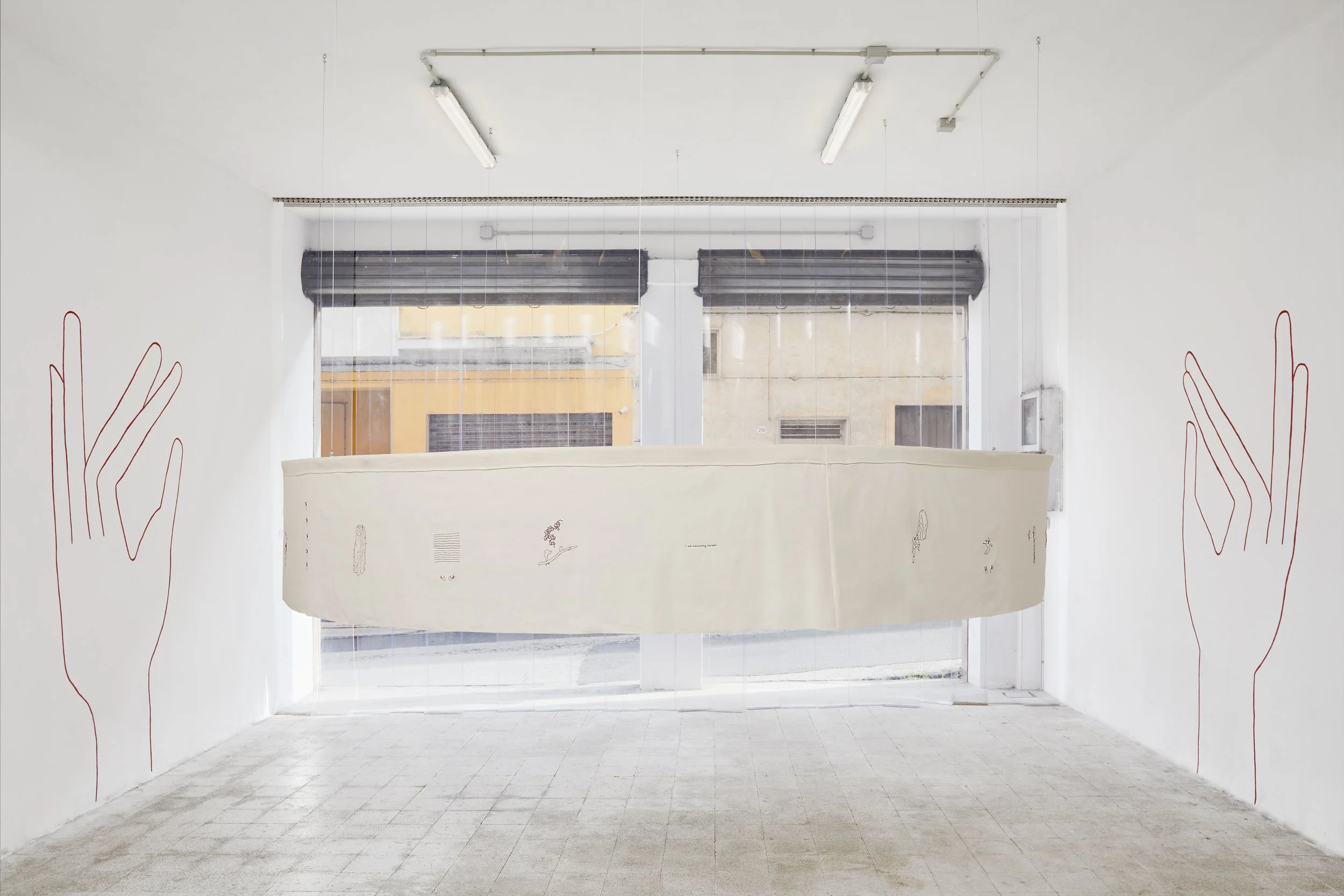
Exhibition view of it is a body, it is your body, Zoe Meyer's solo exhibition, curated by Théo-Mario Coppola, GARAGE FONTANA, Modica, Italy, 2025-2026 | Photo: Natale Leontini, Courtesy: Zoe Meyer and GARAGE FONTANA
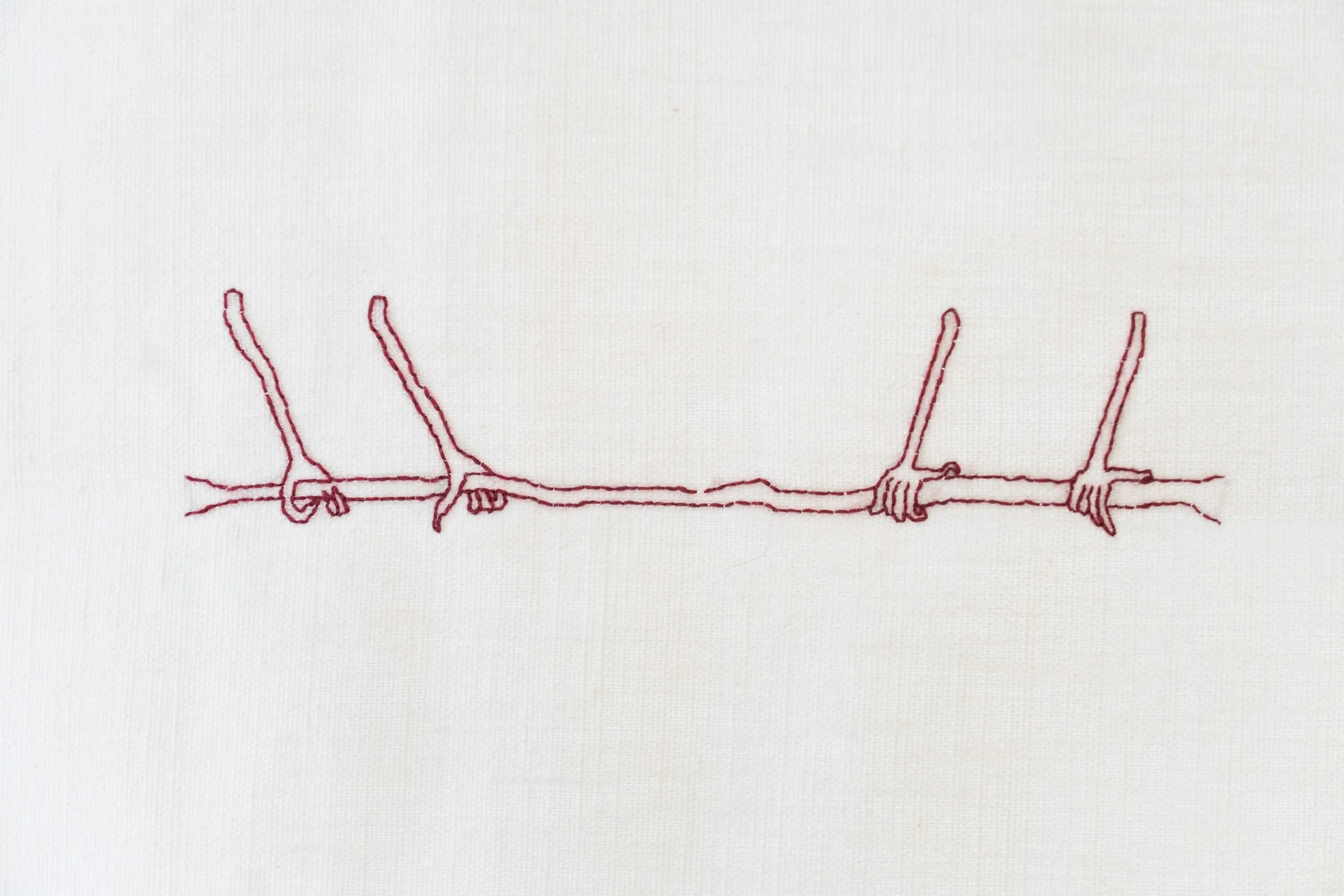
Detail of february waning (2025) as part of it is a body. it is your body., Zoe Meyer's solo exhibition, curated by Théo-Mario Coppola, GARAGE FONTANA, Modica, Italy, 2025-2026 | Photo: Studio Zoe Meyer, Courtesy: Zoe Meyer

Exhibition view of it is a body, it is your body, Zoe Meyer's solo exhibition, curated by Théo-Mario Coppola, GARAGE FONTANA, Modica, Italy, 2025-2026 | Photo: Natale Leontini, Courtesy: Zoe Meyer and GARAGE FONTANA
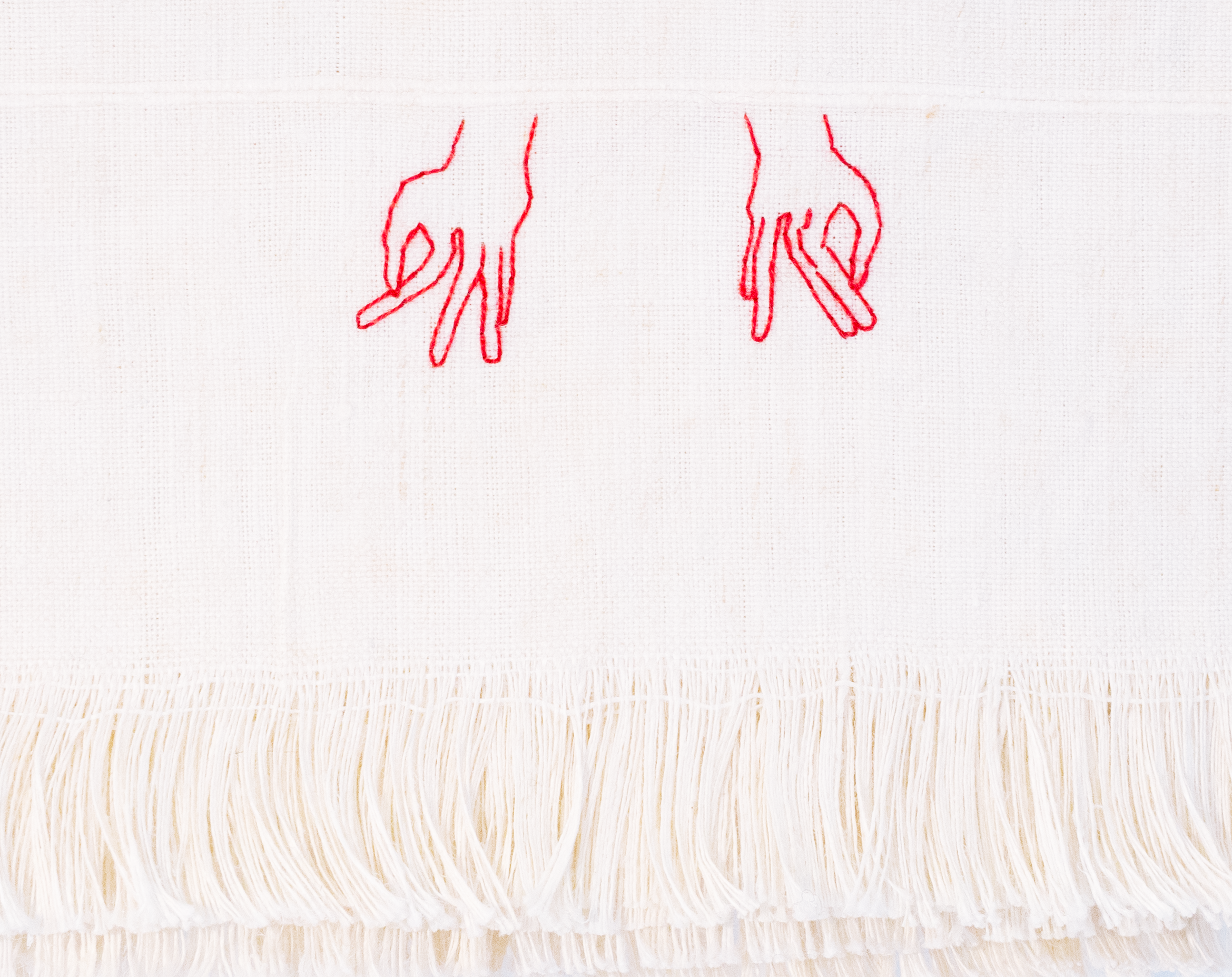
Detail of it is a body. it is your body (2025) by Zoe Meyer | Photo: Studio Zoe Meyer, Courtesy Zoe Meyer

Detail of an osmotic barrier (2025) as part of it is a body. it is your body., Zoe Meyer's solo exhibition, curated by Théo-Mario Coppola, GARAGE FONTANA, Modica, Italy, 2025-2026 | Photo: Studio Zoe Meyer, Courtesy: Zoe Meyer

Exhibition view of it is a body, it is your body, Zoe Meyer's solo exhibition, curated by Théo-Mario Coppola, GARAGE FONTANA, Modica, Italy, 2025-2026 | Photo: Natale Leontini, Courtesy: Zoe Meyer and GARAGE FONTANA


Detail of it is a body. it is your body. (2025) as part of it is a body. it is your body., Zoe Meyer's solo exhibition, curated by Théo-Mario Coppola, GARAGE FONTANA, Modica, Italy, 2025-2026 | Photo: Natale Leontini, Courtesy: Zoe Meyer
Exhibition view of it is a body, it is your body, Zoe Meyer's solo exhibition, curated by Théo-Mario Coppola, GARAGE FONTANA, Modica, Italy, 2025-2026 | Photo: Natale Leontini, Courtesy: Zoe Meyer and GARAGE FONTANA
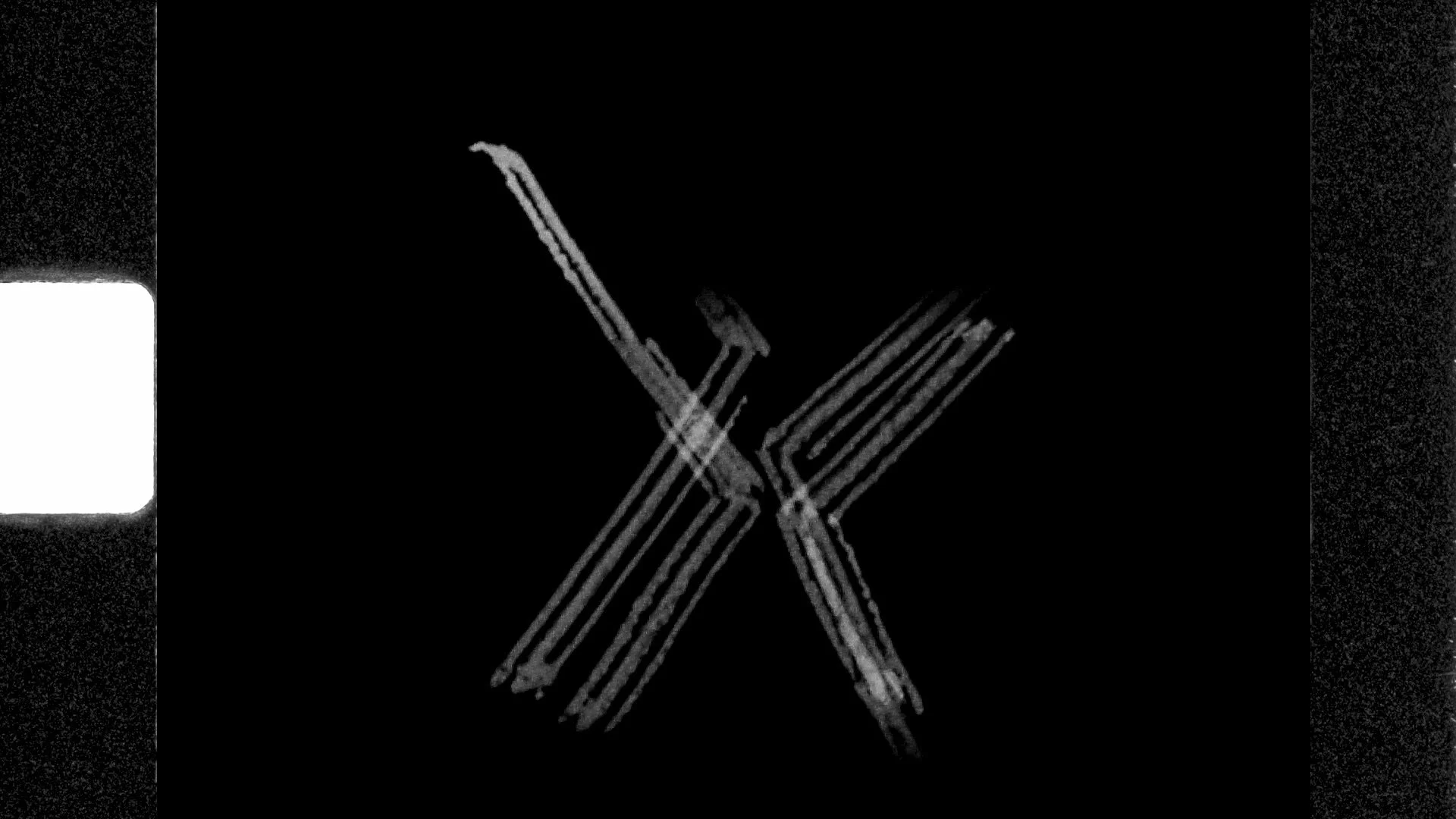
Video still from Geneviève (2019) by Zoe Meyer | Still: Studio Zoe Meyer, Courtesy Zoe Meyer
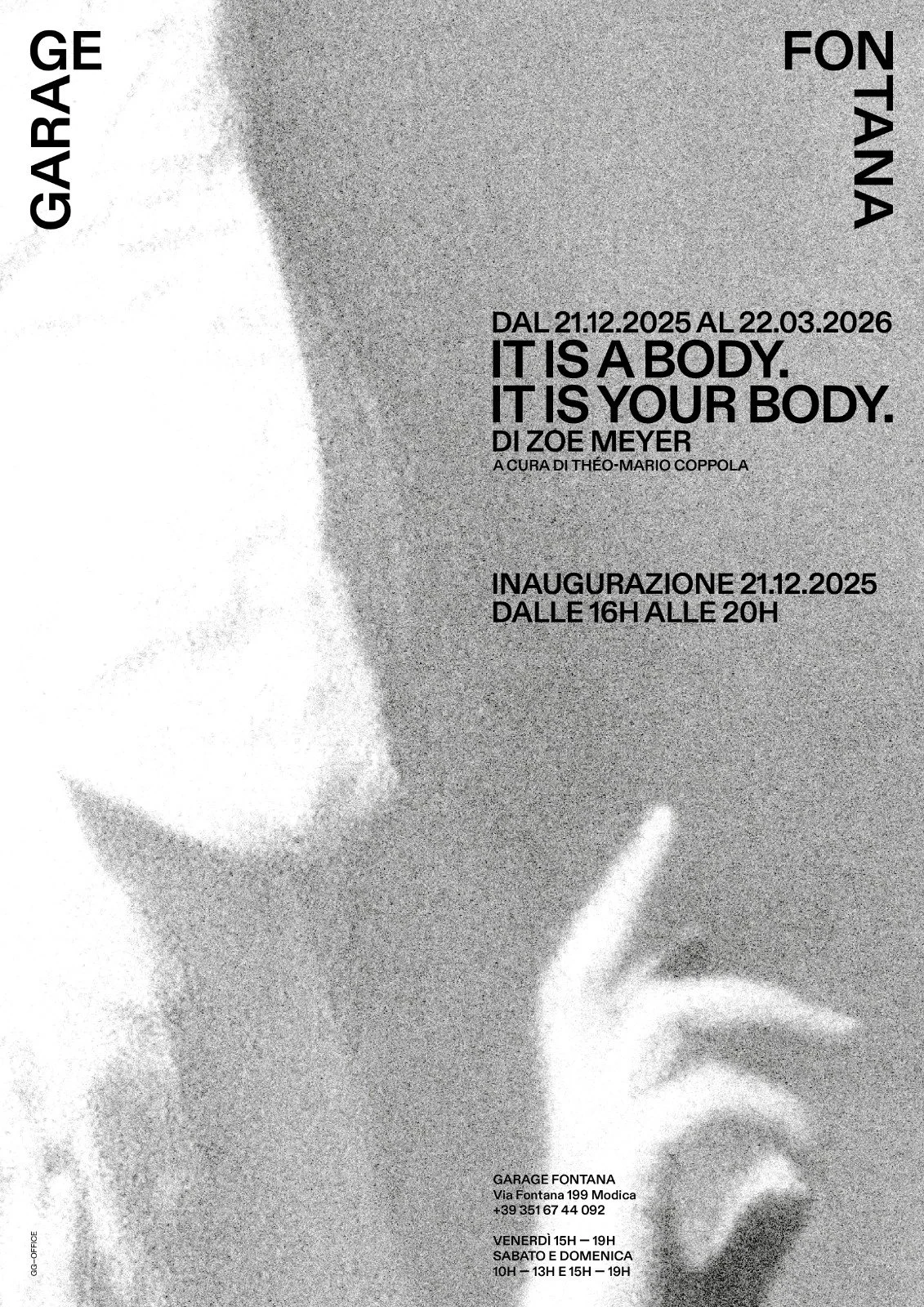
Poster of it is a body. it is your body., solo exhibition of Zoe Meyer, curated by Théo-Mario Coppola – 2025-2026 | designed by Enrico Gisana and GG-OFFICE, 2025
Curated by guest Curator and Arts Writer Théo-Mario Coppola and CALM – Centre d’Art La Meute co-curating leadership Oriane Emery & Jean-Rodolphe Petter, Towards an Affinity of Hammers is a curatorial project consisting of a group exhibition and a public programme.
‘An affinity of hammers does not assume we will automatically be attuned to others who are stopped by what allows us to pass through, even when we ourselves have the experience of being stopped. We have to acquire that affinity. It is what we work toward.’ — Sara Ahmed1
Towards an Affinity of Hammers, the title of the project, refers to ‘An Affinity of Hammers’*, a seminal essay by prominent figure in intersectional studies and feminism Sara Ahmed addressing the silencing and censoring of critical feminist speech. From the idea according to which ‘affinity can be acquired through the work of chipping away at the system’ in relation to endured transphobia and adversity as examined by the author, the project addresses idiosyncratic contexts where the power of struggle is a vehicle for self-existence.
As a curatorial team, we are aware that giving voice to critical, rigorous and emancipatory aesthetic practices needs to be done from a firmly intersectional perspective. We consider the underlying issues of suffering and distress and emphasise the striking emotional force of struggle in what unites rather than divides. The reference to the hammer draws attention to the working tool, its powerful impact through its repetitive use, the noise and energy it generates, as well as the metaphors, comparisons and equivalents it evokes. Through the process of hammering, we learn the patience of struggle, its humility and the joy of being connected to other struggles. At the same time, we recognise other struggles that converge in our direction. In a tireless effort, we attune ourselves, as members of the same musical ensemble would, to the score and inter- pretation of a great global revolution or an aggregate of numerous and diverse uprisings.
Hammering is a manifestation of the tenacious insistence that characterises movements of struggle, initiatives of resistance and long-term protests, in contrast to the one-off, spectacular, high-profile events that most often define the discourse and portrayal of uprising. Here, time and action are not seen as distinct, special moments. Rather, they are seen as a continuous stream that flows across many lives, converging into a bigger scale of meaning that surpasses individuality and ego, and which reflects a shared state of being and its interconnectedness. In the selected works, empowerment and recognition of others, and the insurgent spirit that drives them, is reflected alternatively in individual fate, collective labour, community solidarity, shared loss and grief endured with others, whether it be an intimate experience or that of another person or group.
This project as such could be considered as a form of hammering urging unconditional respect for others, improvement in the living conditions of the most vulnerable, and prioritising solidarity with people at risk in all aspects of life, including art as a place of work, production and discourse. Towards an Affinity of Hammers is also intended as a tribute to perseverance of principle and to obstinacy through action, which are reminders that history has no ending, struggle is repeated and perpetuated in the tiny becoming the great, and individuality converging into collective achievement.
Jean-Rodolphe Petter & Oriane Emery and Théo-Mario Coppola
–
1 – Ahmed, Sara, ‘An Affinity of Hammers’, in Talia M. Bettcher and Susan Stryker, eds., Trans/Feminisms, Transgender Studies Quarterly (TSQ), Volume 3, Issue 1-2, May 2016
Towards an affinity of hammers | 2025-2026
Multi-site curatorial project in Lausanne and Geneva, Switzerland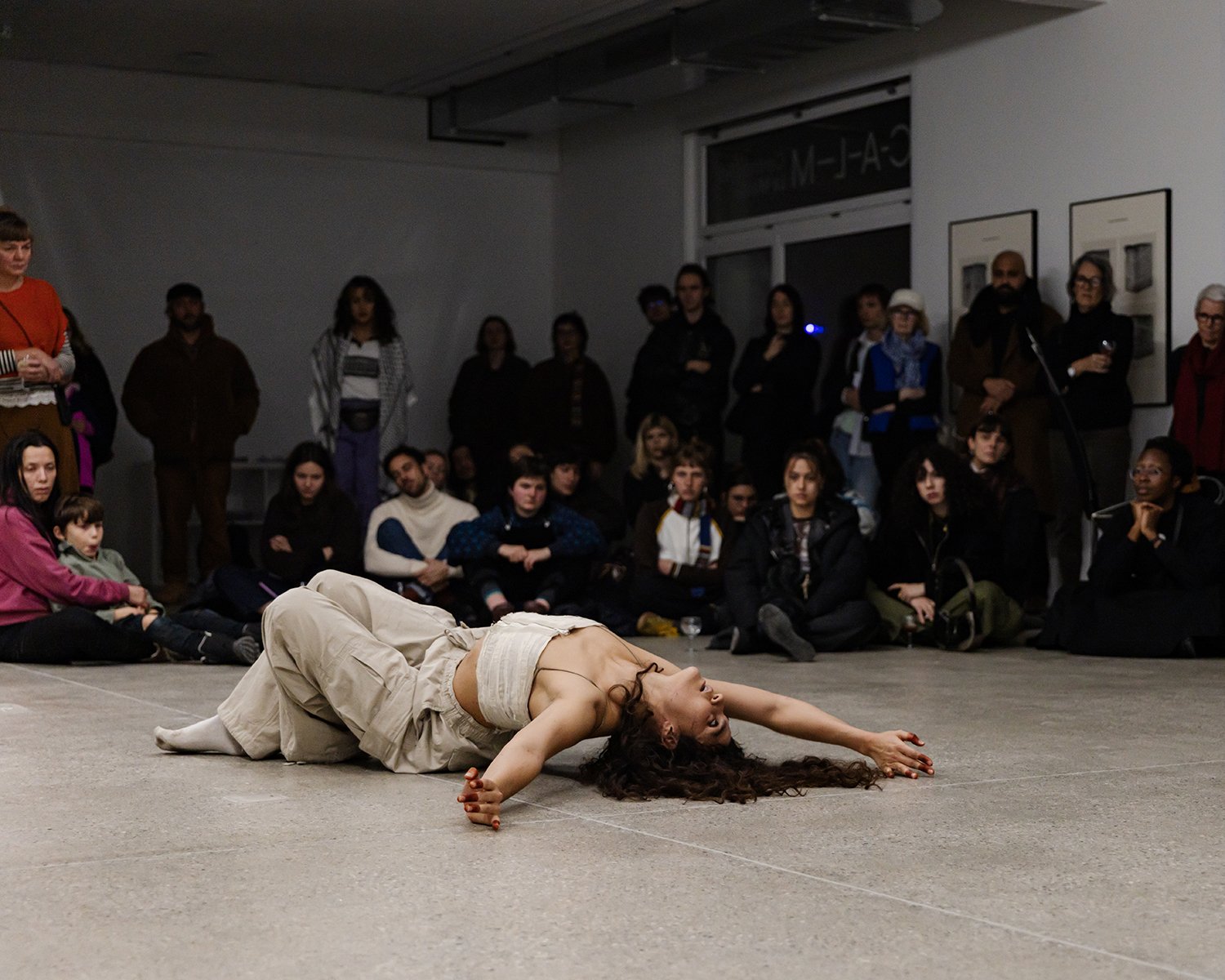
Performance view of R.u.in.es - version XS (2025) by Léna Sophia Bagutti-Khénouf, given by the practitioner on 5 December 2025 at CALM – Centre d'Art La Meute, Lausanne, Switzerland, on the occasion of the exhibition opening as part of Towards an Affinity of Hammers, co-curated by Théo-Mario Coppola and Oriane Emery & Jean-Rodolphe Petter. The performance is a revisited version of a previously existing performance. | Photo: Théo Dufloo, 2025. Courtesy Léna Sophia Bagutti-Khénouf
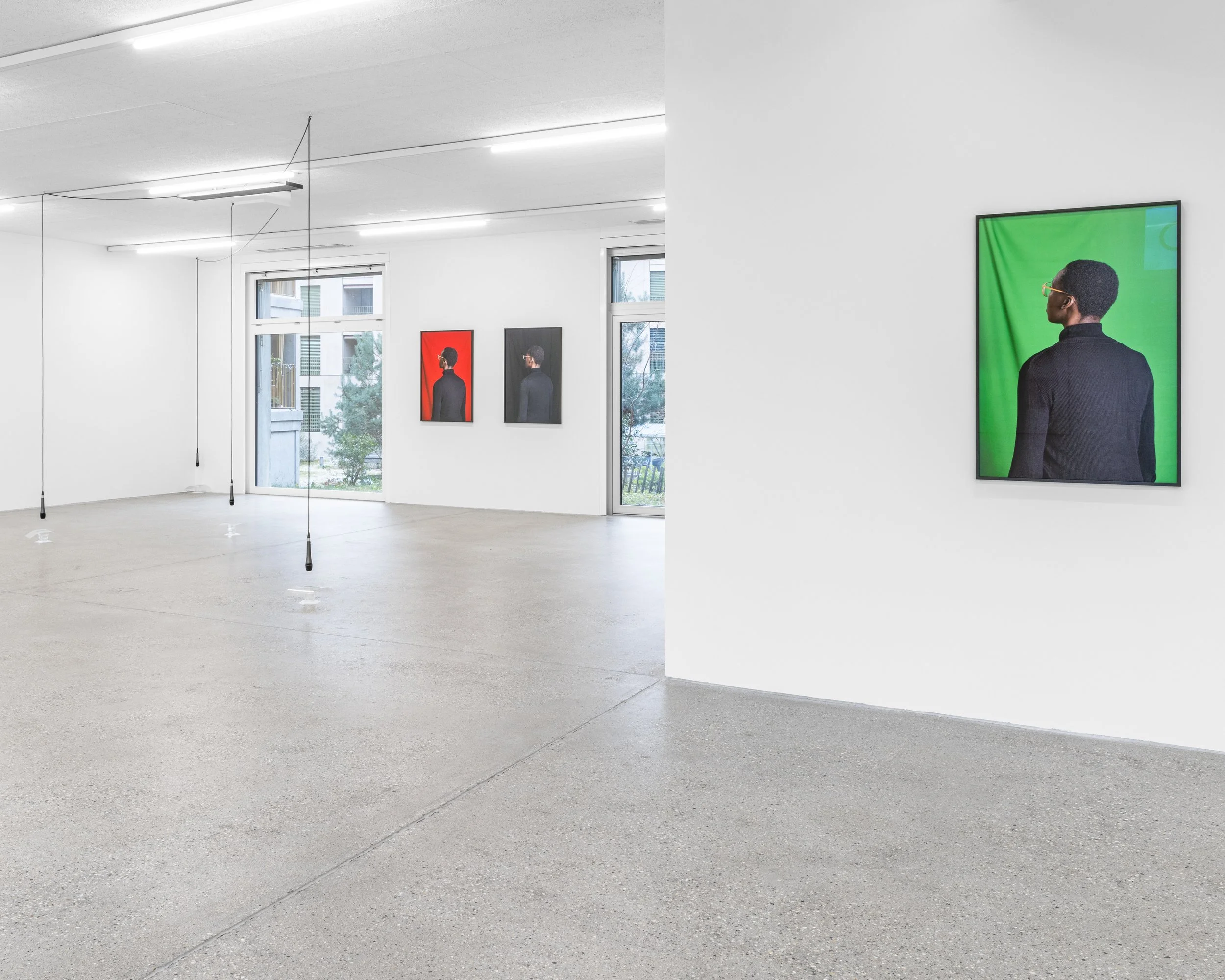
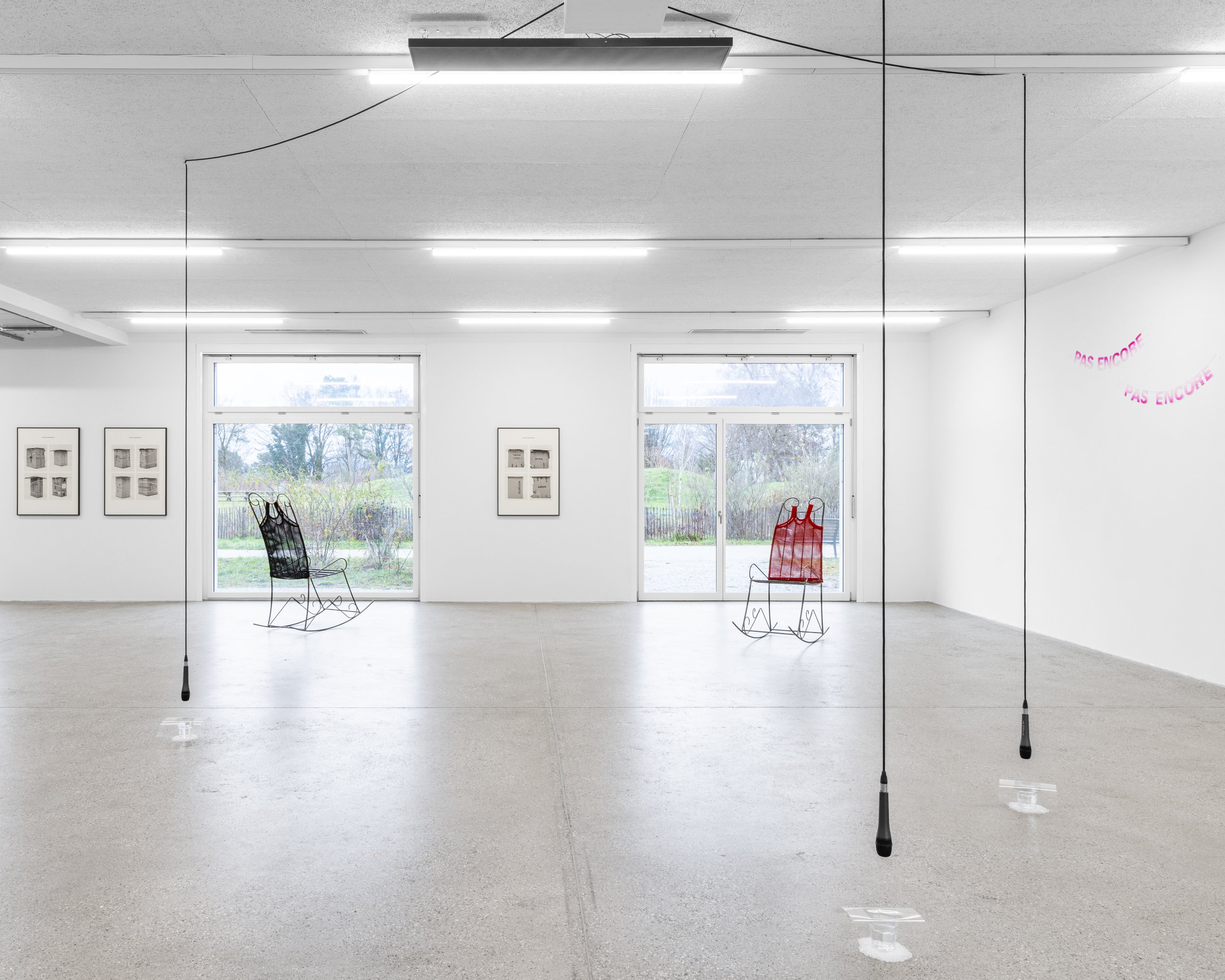
Exhibition view of Towards an Affinity of Hammers, co-curated by Théo-Mario Coppola and Oriane Emery & Jean-Rodolphe Petter, CALM – Centre d’Art La Meute, Lausanne, Switzerland. | Photo: Théo Dufloo.
Exhibition view of Towards an Affinity of Hammers, co-curated by Théo-Mario Coppola and Oriane Emery & Jean-Rodolphe Petter, CALM – Centre d’Art La Meute, Lausanne, Switzerland. | Photo: Théo Dufloo.
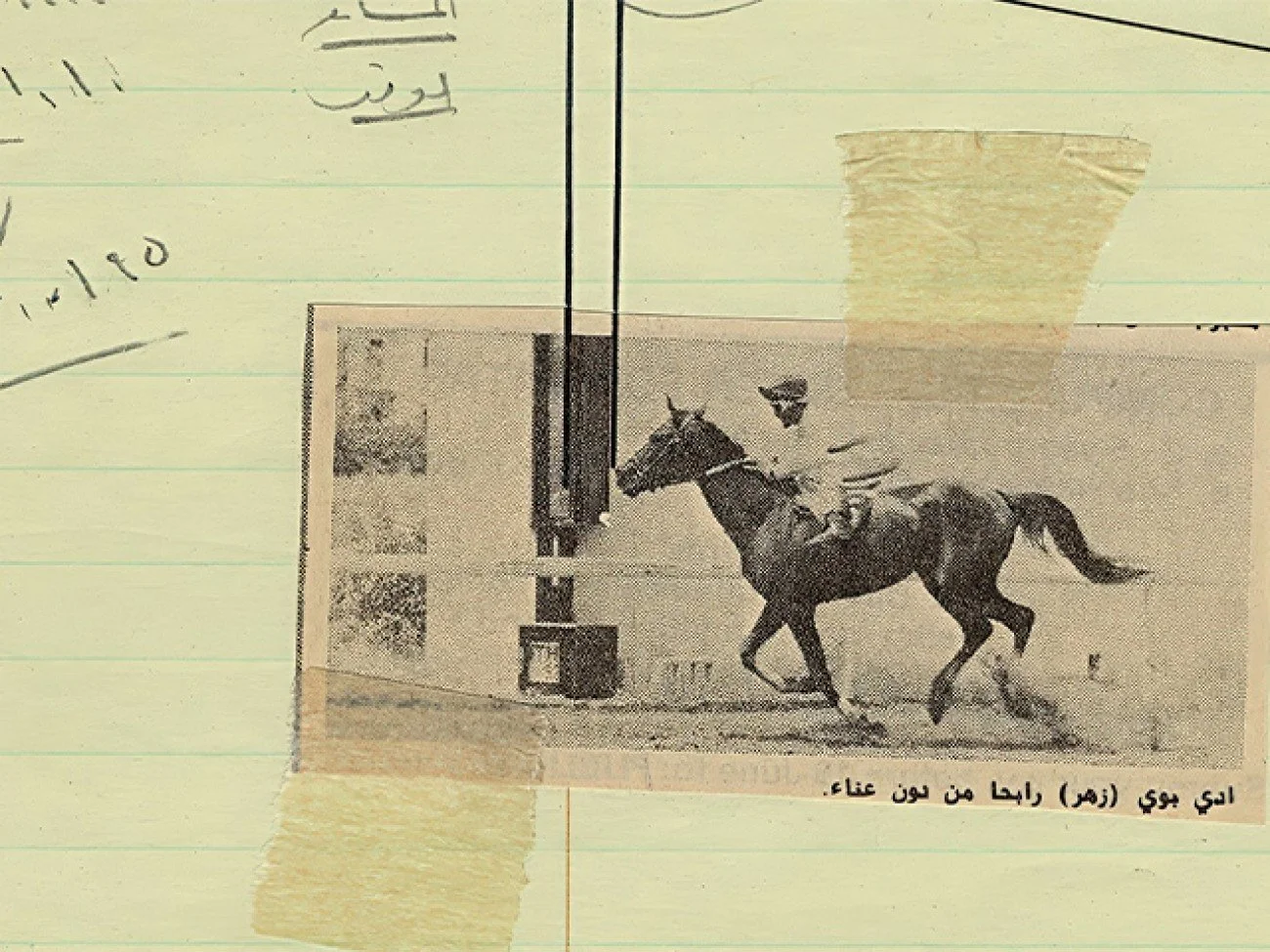
Video still from The Dead Weight of a Quarrel Hangs (1999) by Walid Raad, one of the art works screened at Cinéma Bellevaux on 17 January 2025 as part of Towards an Affinity of Hammers co-curated by Théo-Mario Coppola and Oriane Emery & Jean-Rodolphe Petter. – 2025-2026 | loan from the Fonds Municipal d’Art Contemporain, Geneva, Switzerland. Courtesy Walid Raad and Fonds Municipal d’Art Contemporain.
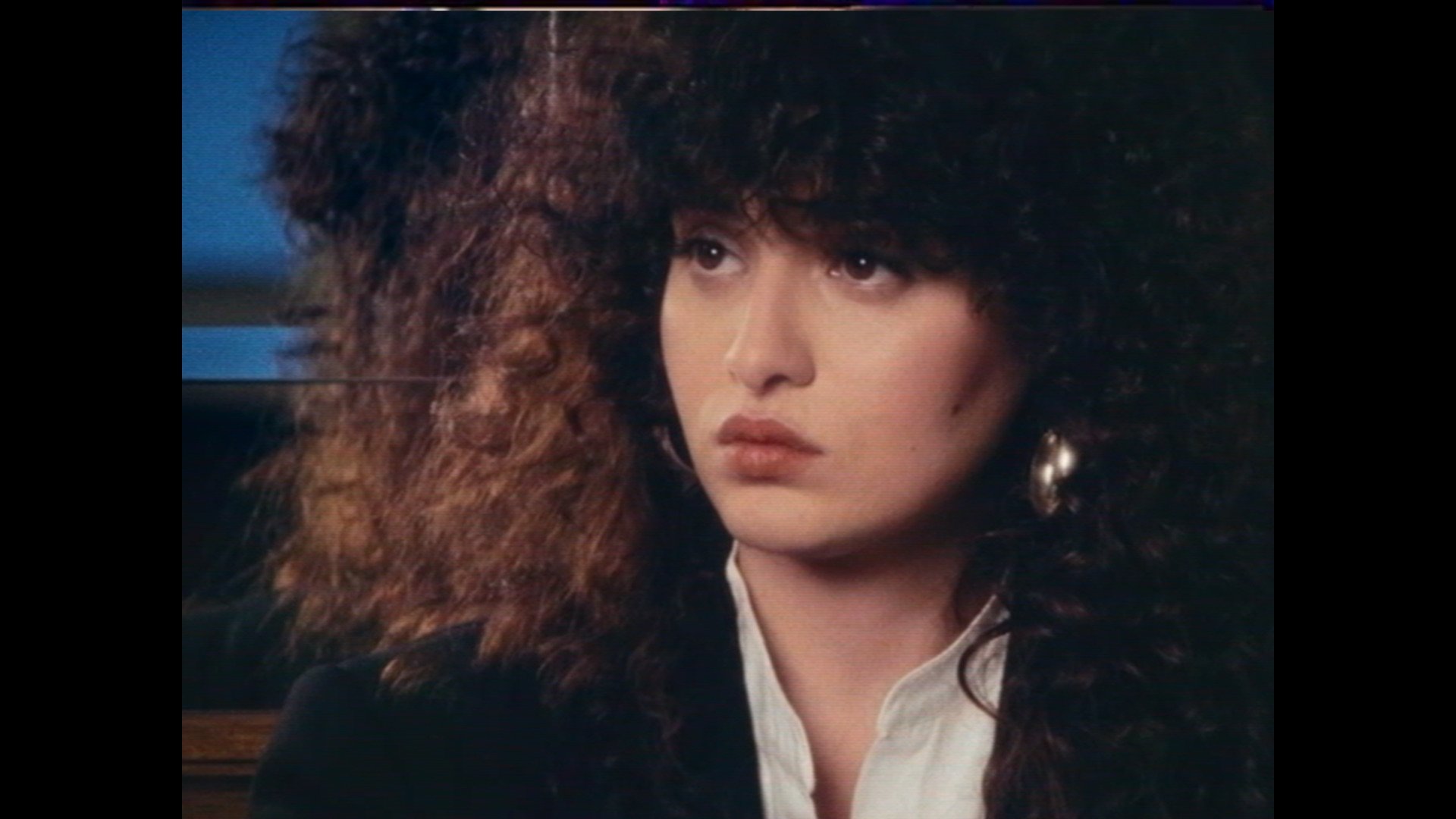
Video still from Maria Schneider, 1983 (2022) by Elisabeth Subrin, one of Elisabeth Subrin’s art works together with Shulie (1997) and Manal Issa, 2024 (2025) screened at Cinéma Spoutnik, Geneva, Switzerland screened in premiere and in the presence of the filmmaker and artist on 30 January 2026, as part of Towards an Affinity of Hammers co-curated by Théo-Mario Coppola and Oriane Emery & Jean-Rodolphe Petter. | loan from Manifest Pictures, Paris, France. Courtesy Elisabeth Subrin and Manifest Pictures.
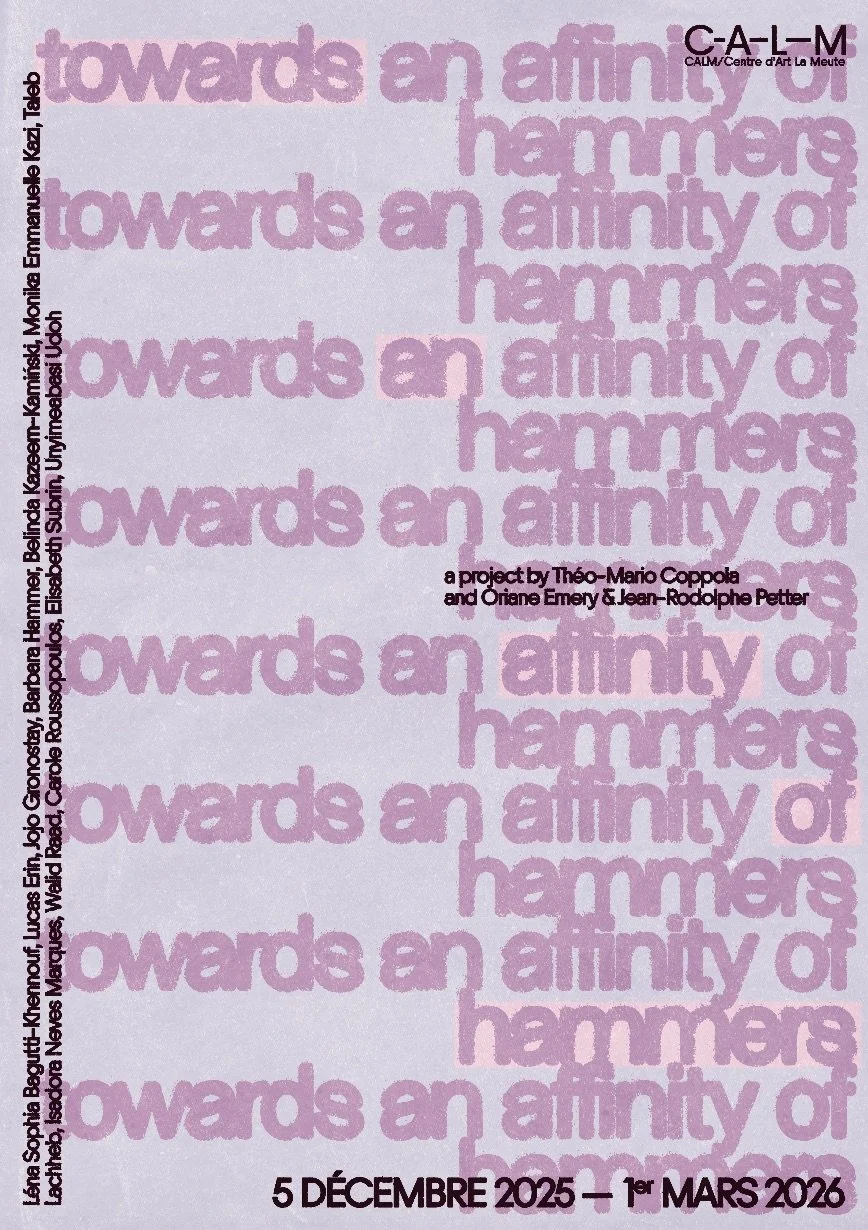
Poster of Towards an Affinity of Hammers, with art works by Léna Sophia Bagutti-Khennouf, Lucas Erin, Jojo Gronostay, Barbara Hammer, Belinda Kazeem-Kamiński, Monika Emmanuelle Kazi,Taleb Lachheb, Isadora Neves Marques, Walid Raad, Carole Roussopoulos (with Atxiya Ali Aden and Sarah Osman), Elisabeth Subrin, and Unyimeabasi Udoh, co-curated by Théo-Mario Coppola and Oriane Emery & Jean-Rodolphe Petter. – 2025-2026 | designed by Mat* Avogadro
Karol Radzisewski QAI X Théo-Mario Coppola | 2022-2023
Commissioned curatorial project crossing digital exhibition, experimental book and art interviewVisual artist and activist Karol Radziszewski and curator and arts writer Théo-Mario Coppola’s digital collaboration is a new commission from the LIAUX online platform. The lens- and text-based project consists of digital photographs of physical documents and objects from the Queer Archives Institute (QAI), and of an extensive interview between the two collaborators. QAI was founded by Karol Radziszewski as a self-managed archive documenting queer lives in several parts of the world, and has been regularly exhibited as part of his art practice. Working as a meta-archive, the online project considers the role of digital versions in the process of documenting.
The project is part of the Milano Digital Week 2022 programme.
Still from the LIAUX website showing the KAROL RADZISEWSKI QAI X THÉO-MARIO COPPOLA project – 2022–2023 | Studio Théo-Mario Coppola, Courtesy Karol Radzisewski, QAI and Théo-Mario Coppola
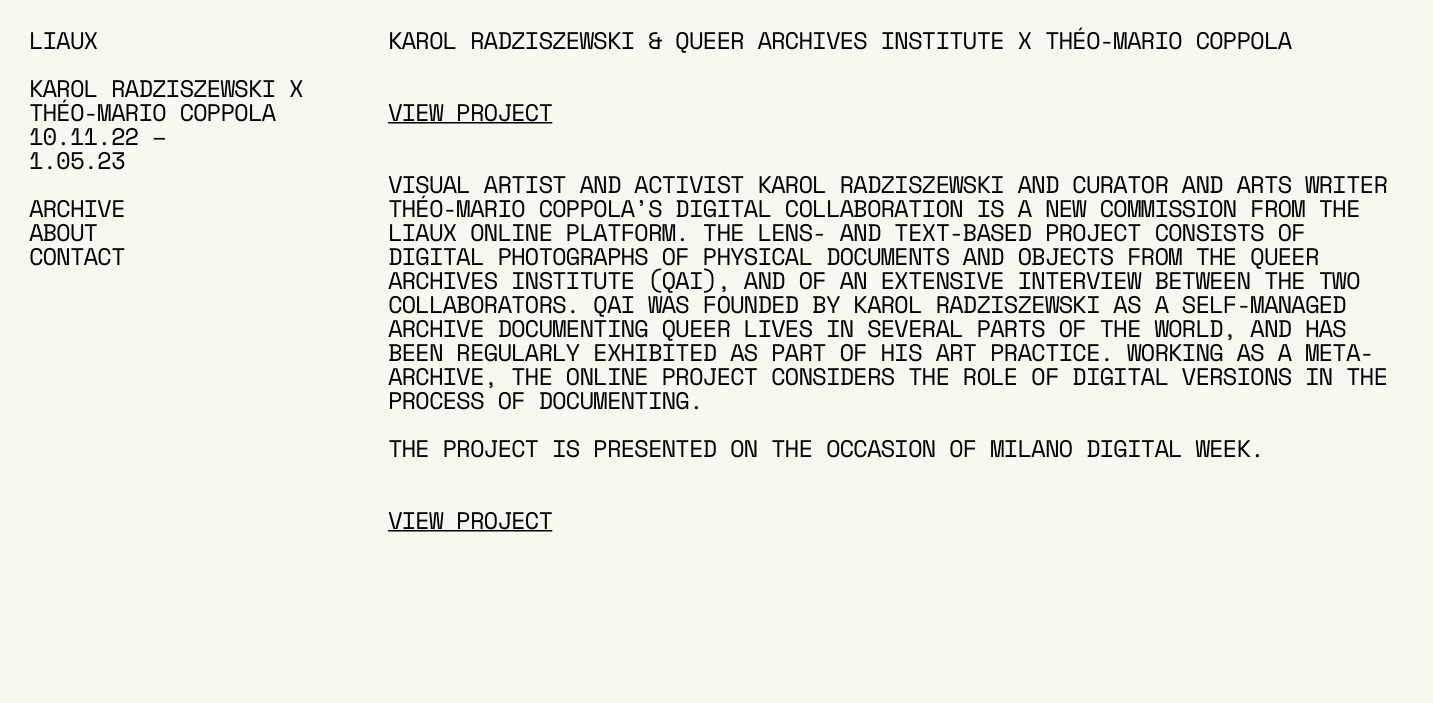
Still from the LIAUX website showing the KAROL RADZISEWSKI QAI X THÉO-MARIO COPPOLA project – 2022–2023 | Studio Théo-Mario Coppola, Courtesy Karol Radzisewski, QAI and Théo-Mario Coppola
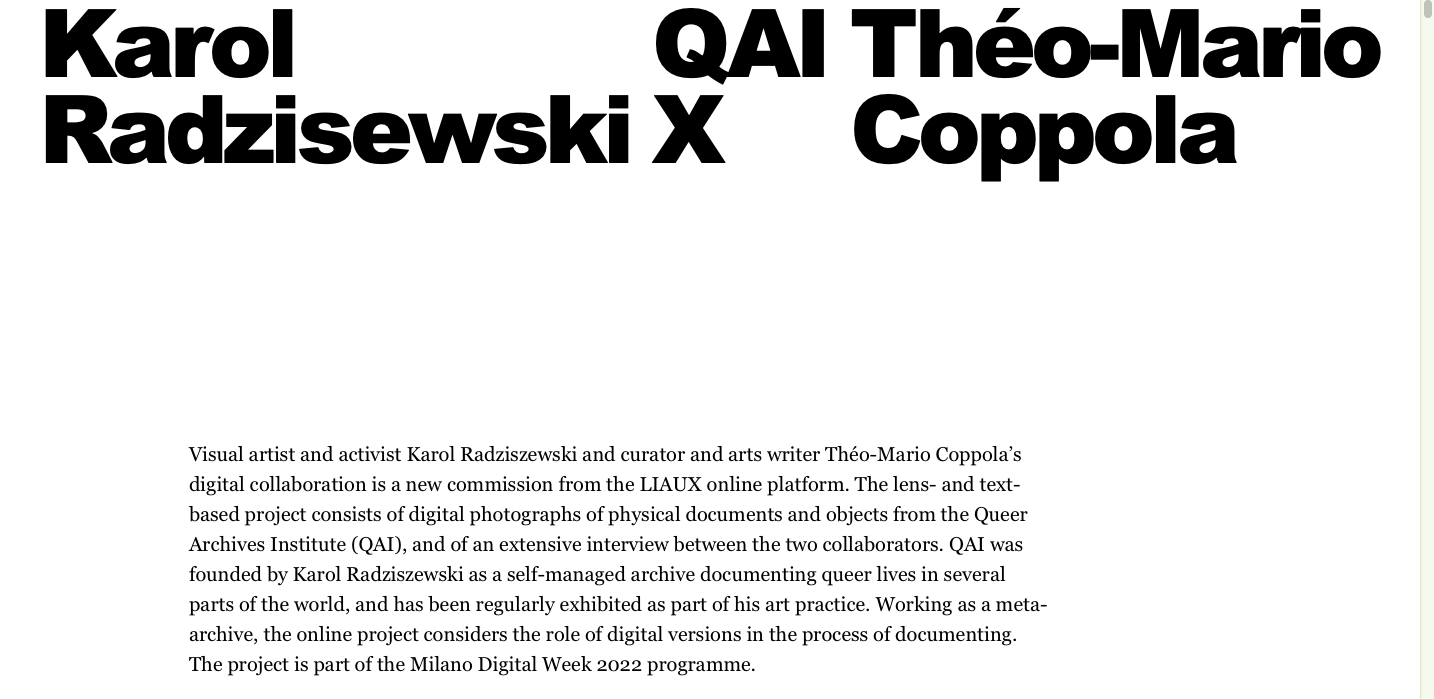
Still from the LIAUX website showing the KAROL RADZISEWSKI QAI X THÉO-MARIO COPPOLA project – 2022–2023 | Studio Théo-Mario Coppola, Courtesy Karol Radzisewski, QAI and Théo-Mario Coppola
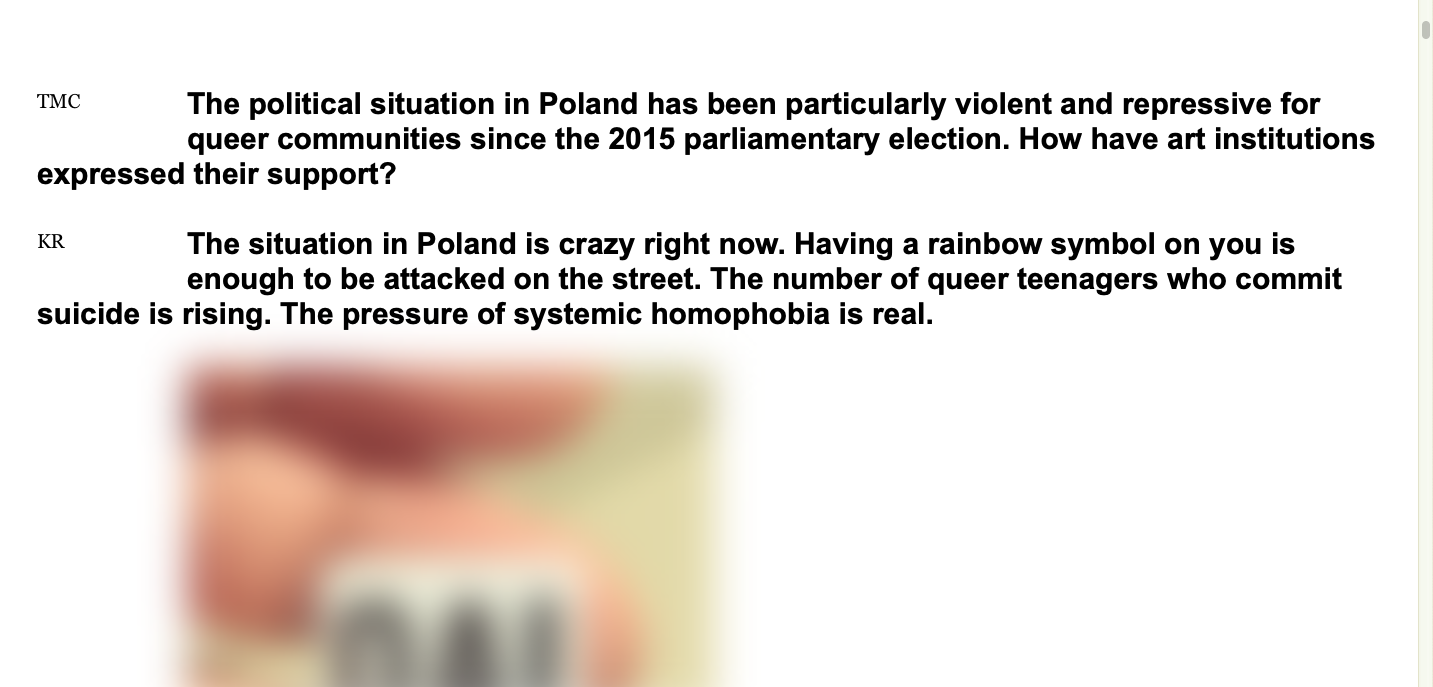
Still from the LIAUX website showing the KAROL RADZISEWSKI QAI X THÉO-MARIO COPPOLA project – 2022–2023 | Studio Théo-Mario Coppola, Courtesy Karol Radzisewski, QAI and Théo-Mario Coppola
Still from the LIAUX website showing the KAROL RADZISEWSKI QAI X THÉO-MARIO COPPOLA project – 2022–2023 | Studio Théo-Mario Coppola, Courtesy Karol Radzisewski, QAI and Théo-Mario Coppola
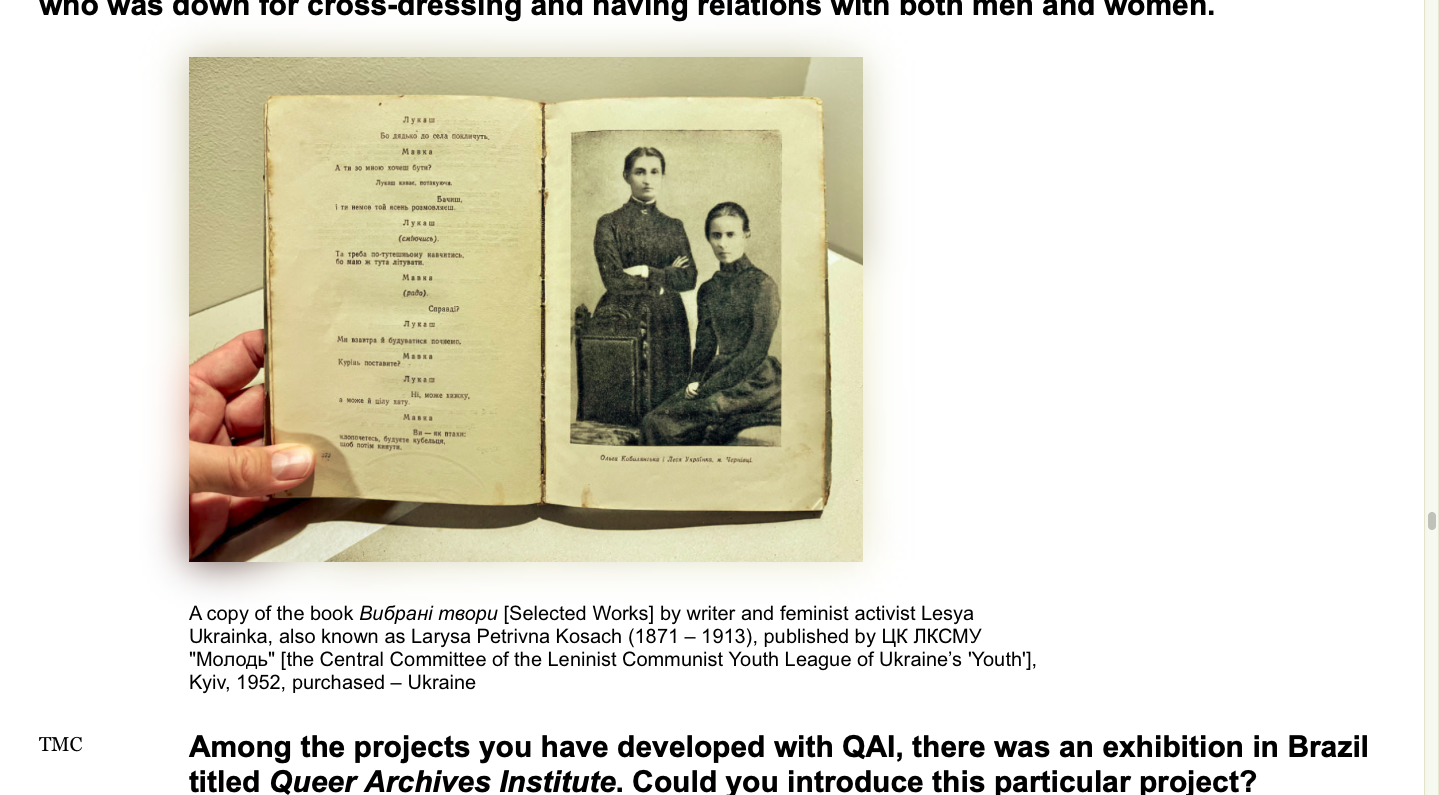
Still from the LIAUX website showing the KAROL RADZISEWSKI QAI X THÉO-MARIO COPPOLA project – 2022–2023 | Studio Théo-Mario Coppola, Courtesy Karol Radzisewski, QAI and Théo-Mario Coppola
Special assembly in solidarity with Ukraine | 2022
In response to the full-scale invasion and war in Ukraine, the Centre Pompidou and Bpi joined forces to organise a meeting in the Forum's public space, giving a voice to figures from the Ukrainian art scene and its diaspora. As artist Nikita Kadan says 'visibility can save lives’. In the context of the special assemby, Ukrainian artists, curators and filmmakers were invited to make their voices heard and share their situations, experiences and concerns. This large-scale meeting was made possible thanks to several groups of art and culture professionals who were actively mobilising in solidarity with Ukraine and urged the institution to be the host of a public assembly, particularly within the art scene, among which Théo-Mario Coppola, the Beyond the Post-Soviet and Initiative for Practices and Visions of Radical Care groups, and not-for-profit initiative La maison de l’ours.
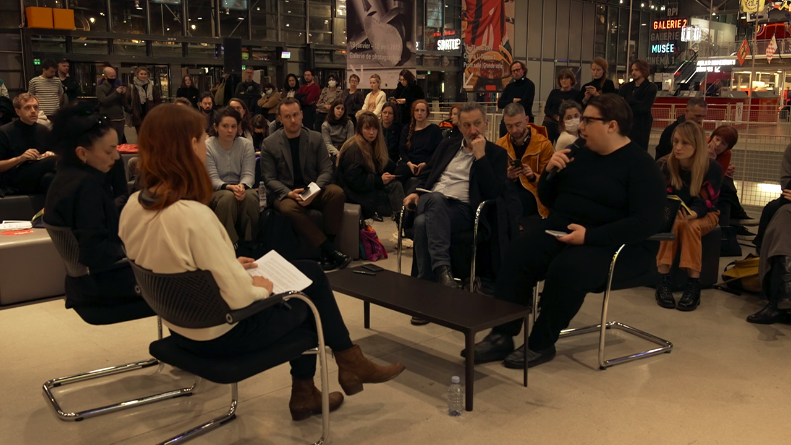
Théo-Mario Coppola introducing AntiGonna (independent filmmaker, actress and performer), with Sylvain Bourmeau (moderator of the panel, journalist and French radio producer, editor-in-chief of the online newspaper AOC) and Kristina Solomoukha (speaker, artist, curator, co-director and co-founder of La maison de l'ours, Paris, France). – 2022 | Still from the video recorded by the Centre Pompidou team.
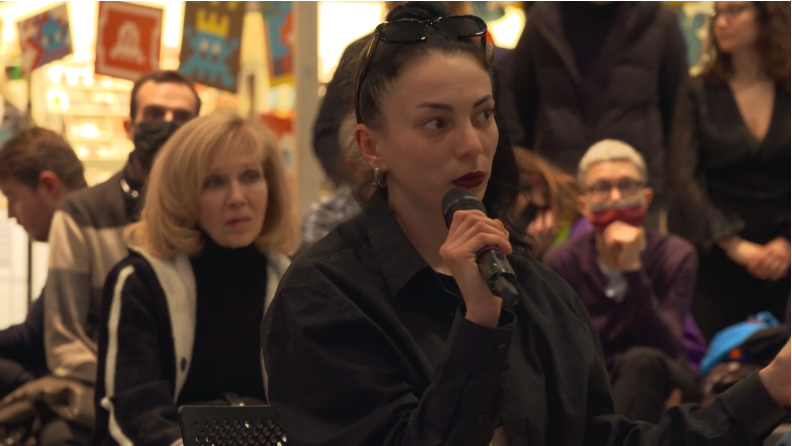
AntiGonna (independent filmmaker, actress and performer) introduced and interviewed by Théo-Mario Coppola – 2022 | Still from the video recorded by the Centre Pompidou team.
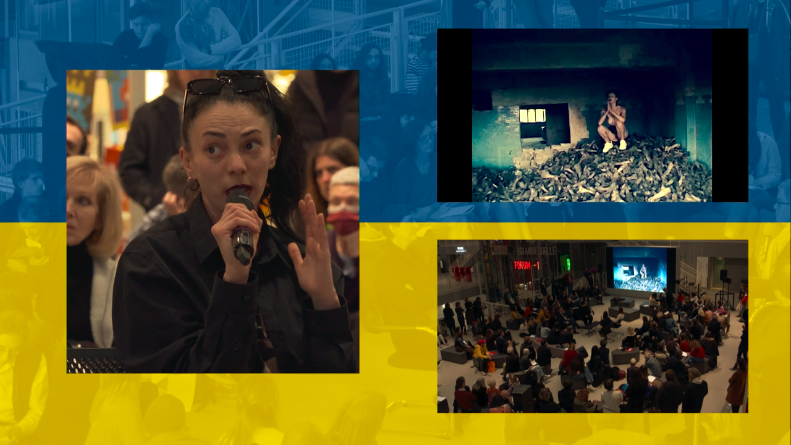
AntiGonna (independent filmmaker, actress and performer) introduced and interviewed by Théo-Mario Coppola – 2022 | Still from the video recorded by the Centre Pompidou team.
Special assembly in solidarity with Ukraine – 2022 | Video recorded by the Centre Pompidou team.
The next update to this section will be completed in April 2025.